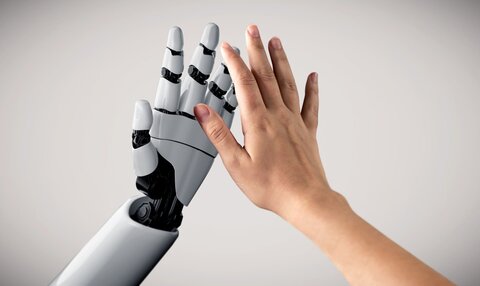
People with Disabilities are systematically training AI systems — and their perspective makes them better.
While globally, Artificial Intelligence systems are associated with poor working conditions and biased data, a Greek model points in the opposite direction: including people with disabilities in the data annotation process is not only an act of social inclusion — it produces fairer and more representative AI models.
The “People with Disabilities Pioneers in Artificial Intelligence”program, run by the non-profit company SciFY, enters its 3rd phase this year, with the goal of transitioning from a pilot stage to systematic, paid professional employment: 10+ trained people with disabilities will carry out approximately 2,000 hours of work on real AI projects, on behalf of companies and research teams.
Why inclusion improves AI
Annotation — the process by which humans “label” data (e.g., images, texts, audio) for use in AI training pipelines — is very often the invisible foundation of modern AI systems. When this work is done by homogeneous groups, models learn a narrow version of reality. Two examples:
- Text comprehension: Text comprehension: responses from a chatbot considered “clear” by most annotators may not be equally clear to a person with autism, who places greater weight on detail and literal phrasing.
- Music perception: a piece of music described as “relaxing” by the average listener may be experienced very differently by someone with autism or a mental disorder — something the 3rd phase of the project will study systematically.
These differences are precisely the information AI companies need to design products that work for everyone, not just the statistically dominant user profile.
“For two years, we piloted how people with disabilities can work in AI, what support they need, and what results they could deliver. This year, we go a step further: we show that when they work, they improve AI. Their contribution can identify ambiguities and biases that many of us often fail to see. That is exactly the kind of quality missing from today’s AI models.”
— Vasilis Giannakopoulos, Chief Marketing Officer, SciFY
From pilot to professional stage
During the first two phases of the program (2024–2025), 39 people with disabilities and 20 mental health professionals were trained in four types of annotation, and over 1,500 hours of supervised work were completed in collaboration with 6 research teams.
The 3rd phase (February–July 2026) introduces two new elements: the systematic, autonomous work of people with disabilities with minimal supervision from mental health professionals, and the development of an open digital annotation management platform that will drastically reduce barriers for companies and researchers looking to launch annotation projects with inclusive teams.
The program is part of SciFY’s award-winning “Pioneers for AI in Greece” initiative, recognized by UNESCO’s IRCAI as one of the top 100 AI projects supporting the United Nations’ 17 Sustainable Development Goals (SDGs).
The “People with Disabilities Pioneers in AI” program is led by SciFY, with the support of METLEN and Athens International Airport.